

Table of Contents
- What Does Open Box Mean and Is It Safe to Buy Open Box Electronics?
- Open Box vs Refurbished: What's the Actual Difference?
- Best Buy Open Box Condition Ratings Explained
- How to Inspect Open Box Appliances and Electronics Before You Buy
- Warranty on Open Box Items: What You're Actually Covered For
- Hidden Costs and Psychological Pricing Traps in Open Box Sales
- Frequently Asked Questions
Last Updated: September 20, 2026
What Does Open Box Mean and Is It Safe to Buy Open Box Electronics?
Open box means a product was returned, opened, or used as a display unit but is still in working condition, sold at a discount. Is it safe to buy open box electronics? Usually yes, provided you inspect the item and confirm the warranty terms first. Essential Market stocks open box items for value-conscious shoppers, and the honest answer is that safety depends far more on how you evaluate the specific unit than on the label itself.
The Real Risks vs. the Real Savings
The genuine risks are narrow and identifiable: cosmetic damage, missing accessories, shortened warranty coverage, and the occasional unit that was returned because of an intermittent fault the first buyer never documented. A common mistake is assuming "returned" means "defective." Most customer returns happen because of sizing, color, or changed minds, not hardware failure.
Open Box vs Refurbished: What's the Actual Difference?
Open box and refurbished are not the same thing, and retailers often blur the line. An open box item is typically a customer return or display unit that has not been repaired or rebuilt. A refurbished item has usually been inspected, tested, and in many cases repaired by the manufacturer or an authorized dealer before resale.
| Factor | Open Box | Refurbished |
|---|---|---|
| Typical origin | Customer return, display unit | Returned, then tested/repaired |
| Condition | Varies by rating | Restored to working spec |
| Warranty | Often store-only | Often manufacturer-backed |
| Accessories | May be incomplete | Usually complete |
| Price | Lowest | Slightly higher |
Best Buy Open Box Condition Ratings Explained
Retailers that use condition ratings grade open box items on a tiered scale, and understanding that scale is the fastest way to judge value.
How Retailers Grade Open Box Items
Most grading systems run from excellent to fair:
- Excellent: Looks new, may include original packaging and all accessories. Minimal to no cosmetic wear.
- Good: Fully functional, may show light cosmetic damage or be missing minor accessories.
- Fair: Works as intended but shows clear signs of use, scratches, or missing components.
The grade is the retailer's own assessment, not an independent certification. Treat it as a starting point, not a guarantee.
How to Inspect Open Box Appliances and Electronics Before You Buy
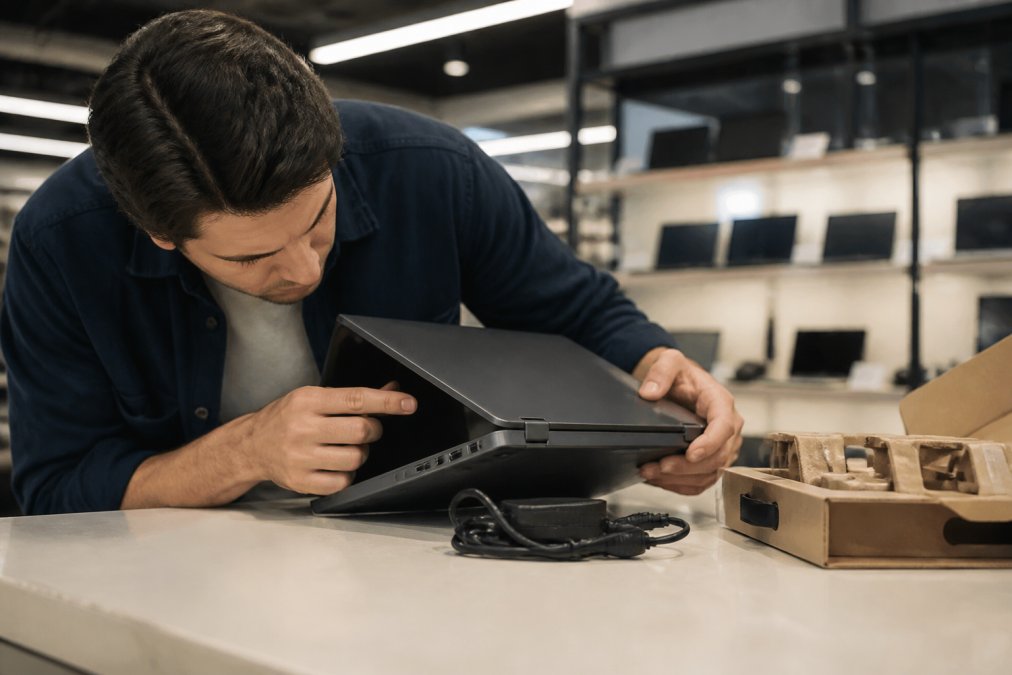
How to inspect open box appliances comes down to testing the functions that fail silently: power, connectivity, moving parts, and included accessories. But a single generic checklist underserves you, because a dead pixel on a TV, a swollen battery in a laptop, and a failing compressor in a refrigerator are three completely different failure modes with three different tests. Use the category-specific framework below.
Universal Pre-Purchase Steps (Do These First)
- Confirm the serial number on the unit matches the box, the receipt, and any warranty card
- Verify the unit is not reported lost or stolen if the retailer offers a serial lookup
- Power the device on and run it for at least ten minutes, not thirty seconds
- Verify all advertised accessories are present and match the original parts list
- Ask for the return policy and any restocking fee in writing
- Confirm whether the unit has been factory reset and whether firmware is current
TVs and Monitors
- Display a solid white, black, red, green, and blue image (most TVs have a built-in test pattern under Settings, or you can cast one from a phone) to expose dead pixels, stuck pixels, and uniformity blotches.
- Check for backlight bleed by viewing a full-black screen in a dim area of the store.
- Inspect the panel edges and corners for pressure marks, which often indicate the unit was dropped or stacked improperly.
- Confirm the stand, remote, power cord, and any wall-mount hardware are included, replacement remotes and proprietary stands are frequently the missing piece.
- Ask the associate to run the TV for 15 minutes; some panel faults and HDMI handshake issues only appear after warm-up.
Laptops and Tablets
- Open and close the lid several times and check the hinge tension, a loose or grinding hinge is a common return reason.
- Run a battery health report (on most laptops this is available through the system's built-in diagnostics) and confirm the design capacity versus current capacity. A unit with heavy cycle count is not really "like new."
- Test every USB, HDMI, and audio port with a known-good cable or device.
- Check the keyboard for stuck or non-registering keys and the trackpad for dead zones.
- Look for signs of liquid damage around the ports, speaker grilles, and under the bottom panel screws.
- Confirm the charger wattage matches the model's requirement, a mismatched adapter is a red flag that the original was lost.
Kitchen Appliances and Large Appliances
- For refrigerators, listen to the compressor cycle for at least several minutes and confirm it runs quietly and cools. Check door seals by closing a dollar bill in the door, if it slides out easily, the gasket is worn.
- For washers and dryers, run a short cycle and listen for bearing noise or unbalanced spin. Check the drum for rust or residue.
- For dishwashers, confirm the door latch, spray arms, and drain pump operate, and inspect the interior for hard-water scale.
- For ranges and ovens, test every burner and confirm the oven reaches temperature; check the door gasket and hinges.
- Confirm the model number matches the listing, appliance model suffixes often indicate different capacities or feature sets that look identical on the floor.
What to Skip Testing in Store
Some checks are impractical at the counter. For those, negotiate the return window instead: ask for a written guarantee that you can return the unit for a full refund, not store credit, if a defect appears within the first 14 to 30 days. Get the associate's name and the date on the receipt.
A "Good" or "Fair" rating often means the original packaging is gone and a remote, cable, or mounting bracket is missing. Replacing those parts can erase the discount, so price the missing accessories before you commit.
Warranty on Open Box Items: What You're Actually Covered For
Warranty on open box items is where buyers get burned most often, because coverage varies dramatically by retailer, product category, and even by how the unit was originally sold. The vague advice you'll find elsewhere, "check the warranty", is useless without understanding how the underlying mechanisms actually work. Here is the framework most guides skip.
Does the Manufacturer Warranty Survive the Open Box Sale?
The short answer: usually yes, but not always, and the exceptions are expensive.
- The retailer is an authorized dealer for that brand.
- The unit's serial number has not already been registered to the original buyer in a way that blocks a new registration.
Store Warranty vs. Manufacturer Warranty: What You're Actually Comparing
These are not interchangeable, and the difference matters most on expensive items.
| Coverage type | Who honors it | Typical length | What it usually covers |
|---|---|---|---|
| Manufacturer warranty | The brand or its authorized service network | Often the remainder of the original term (commonly 90 days to 1 year) | Defects in materials and workmanship |
| Store warranty / return window | The retailer only | Usually 14-90 days | Return or exchange, not repair |
| Extended protection plan | Third-party administrator | 1-4 years | Varies; often excludes cosmetic damage and consumables |
Credit Card Purchase Protections
Many major credit cards extend the manufacturer's warranty by up to one additional year on eligible purchases, and some offer purchase protection against damage or theft for the first 90 days. These benefits typically require that you charge the full purchase price to the card and that the item carry a valid manufacturer warranty in the first place. If the open box unit has no manufacturer warranty, the card benefit usually does not apply.
Questions to Get Answered in Writing Before You Pay
- Who is the warrantor, the manufacturer, the retailer, or a third party?
- What is the remaining term, and does it start from the original sale date or from your purchase date?
- Does the warranty cover parts and labor, or parts only?
- Is in-home service included for large appliances, or must you transport the unit?
- What voids coverage, unauthorized repair, missing serial number, commercial use?
- Is the unit eligible for an extended protection plan, and what does that plan exclude?
The single most important question is not "does it have a warranty" but "who honors it, for how long, and from what start date." A store return window on a cheap accessory is fine. On a refrigerator or a laptop, you want the manufacturer's name on the coverage, in writing.
Hidden Costs and Psychological Pricing Traps in Open Box Sales
Hidden costs and pricing psychology are the two forces that quietly turn a "deal" into a mistake. The most common hidden cost is a restocking fee, which some retailers charge on open box returns and which can cancel out the savings on a marginal purchase. Missing accessories are the second: a replacement remote, power adapter, or mounting kit can cost more than the discount you received.
A restocking fee on an open box return can wipe out the entire discount. Always confirm the fee before buying, especially on higher-ticket electronics and appliances.
Frequently Asked Questions
Is buying an open box risky?
It can be, but the risk depends on where you buy and what condition the item is in. Open box electronics are customer returns, display units, or overstock that have been opened but not necessarily used. The main risks are missing accessories, cosmetic damage, or a shorter warranty. Buying from a retailer that tests items and offers a clear return policy reduces that risk significantly. Always inspect the product and confirm the condition rating before purchasing.
What is the difference between open box and refurbished?
Open box items were typically returned by a customer or used as a display unit and may never have been used at all. Refurbished items have usually been inspected, repaired if needed, and restored to working condition by the manufacturer or a third party. Refurbished products often come with a separate warranty, while open box items usually carry the original manufacturer warranty or a shortened store warranty. The condition and coverage differ, so check the label carefully.
Does open box mean the product is defective?
No. Most open box items are returned because the buyer changed their mind, found a better price, or the item did not fit their needs. A smaller percentage are returned due to technical defects, but reputable retailers test returns before reselling them. The condition rating tells you what to expect: items rated 'excellent' or 'like new' typically have no defects, while 'fair' ratings may note cosmetic damage or missing accessories.
How can I tell if an open box item is in good condition?
Ask the seller for the condition rating and what it includes. Inspect the product in person if possible: check the screen, ports, buttons, and casing for cosmetic damage. Confirm that all original accessories, cables, and manuals are present. Ask whether the item has been tested and whether the serial number matches the packaging. For appliances, request a demonstration or proof of product testing. A written return policy and proof of purchase protect you if something fails after purchase.